Choose a wooden spoon when you want a firm tool for stirring or serving; choose a flexible silicone spatula when you want its edge to follow a mixing bowl. You may need both. The useful tradeoffs are how the head moves, what it can carry and how you will clean it.
Firmness for stirring, flexibility for scraping
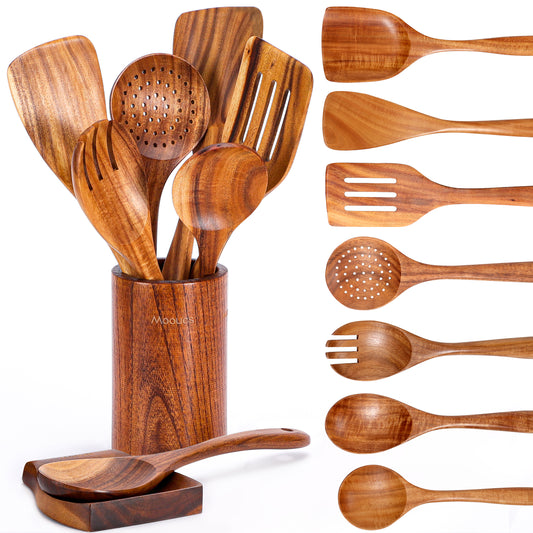
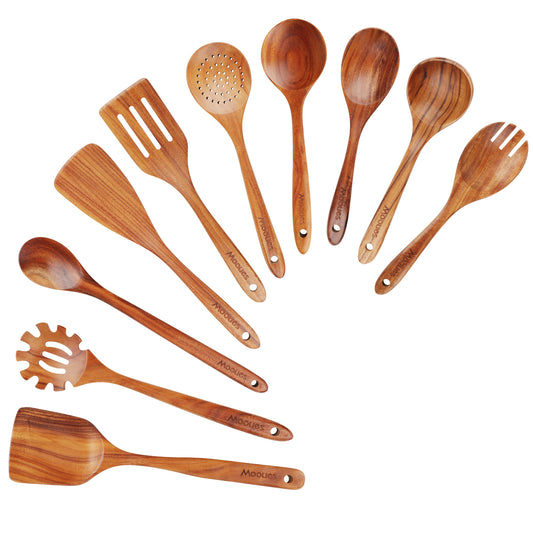
A wooden spoon keeps its shape as you move ingredients around a pot. Its bowl can carry some sauce with the food; a flat wooden turner presents a different surface for lifting. That firm feel can suit stirring and serving, but it will not bend around a bowl the way a flexible spatula does.
For scraping batter from the curved side of a bowl, a flexible silicone edge can follow the surface. A very flexible head may be less useful when you want firm support under food. Silicone tools vary in thickness and internal support, so a thin scraping spatula and a reinforced turner should not be treated as interchangeable.
Match the head to the task before deciding on material. Our utensil shape guide shows the difference between stirring, turning and draining tools.
The cleanup tradeoff
Mooues teak utensils require hand washing and full drying. That adds a separate step if everything else goes into the dishwasher. If that step is unwelcome, look for a silicone utensil explicitly labeled dishwasher-safe.
Mixed construction changes the answer. Le Creuset's care guide permits dishwashing for its all-silicone items, but tells owners to hand-wash wooden handles. On its removable-head tools, the silicone blade and handle are cleaned separately. A wooden handle is therefore worth noticing before you choose a tool for easy machine cleanup.
What about nonstick pans and heat?
Use a material permitted by your cookware's care guide, and keep damaged or rough edges out of the pan. Both the tool's condition and the movement matter; see choosing wooden tools for nonstick cookware for practical examples.
For hot work, use the temperature limits stated for the particular tool. A rating for one silicone spatula does not establish the limit of another, and a wooden handle does not make a tool suitable to leave against a heat source. Put the utensil on a rest between uses.
Build a small combination around a meal
For pasta and a salad, you might use a firm spoon to stir sauce and a pair of servers to lift the leaves. For a cake, a flexible spatula may be more useful for transferring batter from bowl to pan. Keep the tools that earn their place in those meals rather than replacing the whole drawer with one material.
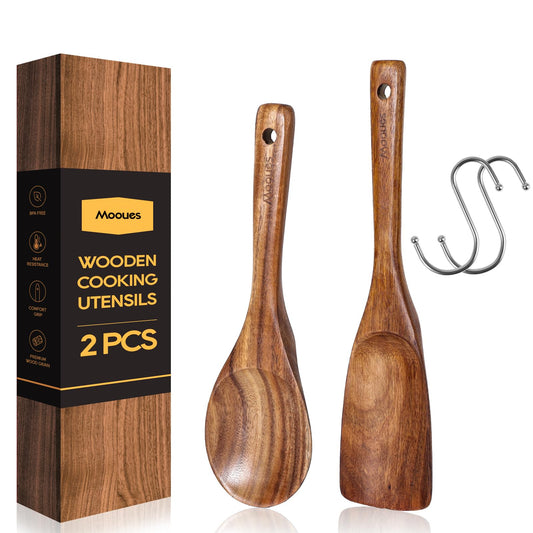
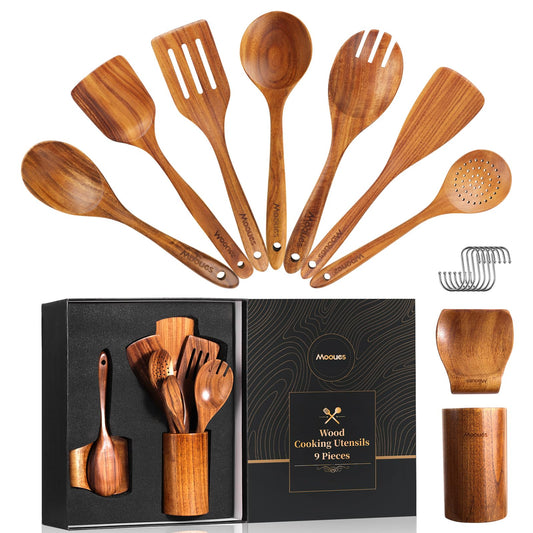
If you are choosing the wooden portion, the Mooues nine-piece set contains seven handheld tools, a holder and a spoon rest. If you already have most shapes, an individual utensil may be enough. The set-size comparison lists the accessory differences, while the cleaning guide shows the hand-wash routine to expect.