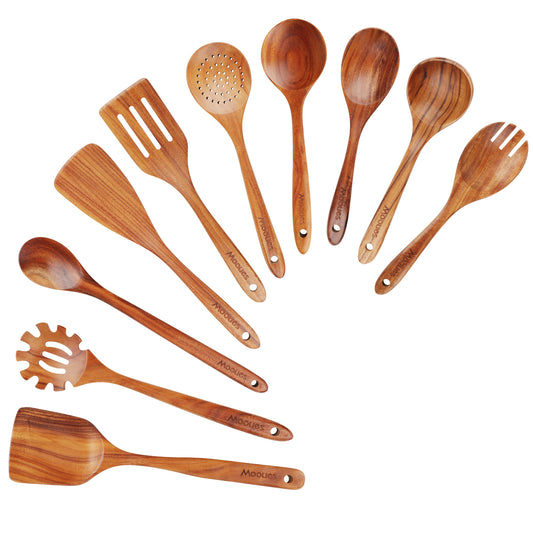
Start with the working end of the utensil. A deep or curved head holds food, a flatter edge helps move it, and holes let liquid drain. These differences are more useful when choosing tools than simply counting how many are in a set.
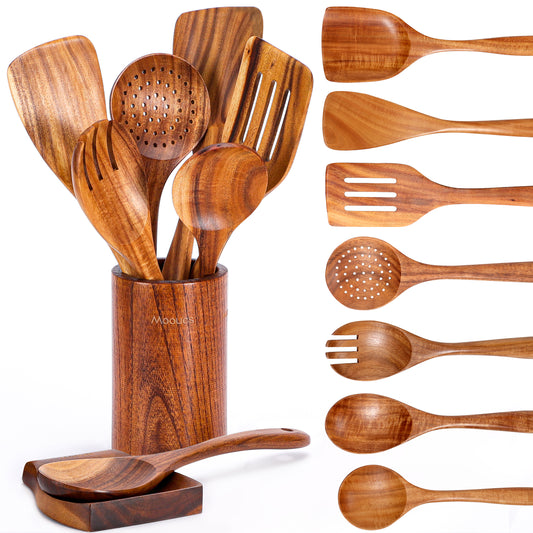
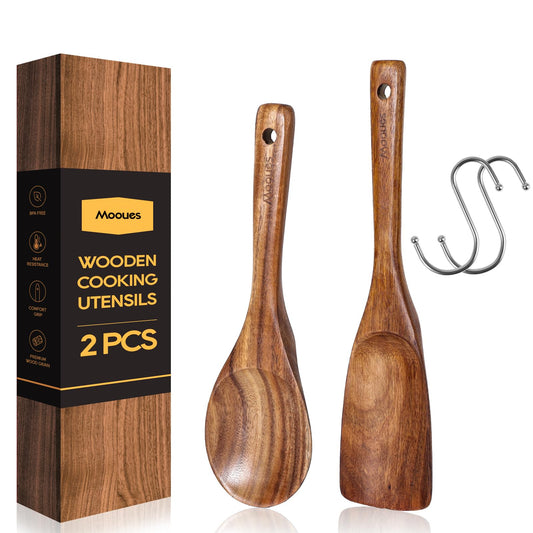
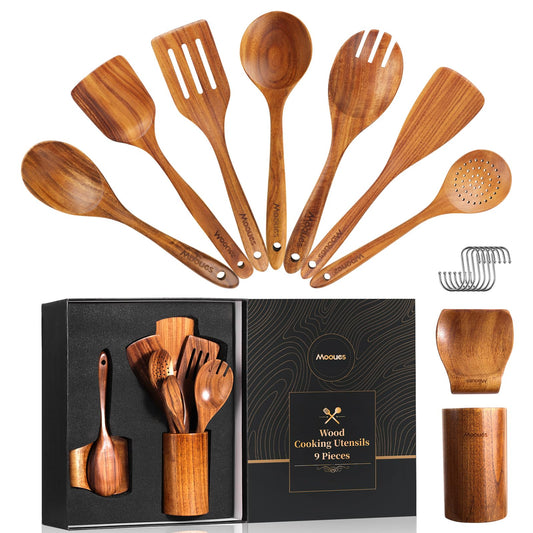
Below are three examples from the Mooues range, followed by the accessories and paired tools you may find in a larger set. Product photos show the actual listed shapes; check each listing for its current details.
Solid stirring spoon

Use a solid spoon for stirring and bringing ingredients together. Because the head has no drain holes, it also lets you move some sauce or liquid with the food.
Flat turner

Compare a flatter edge when you want to turn or move food in a pan. Match its width to the food and cookware; a broad turner serves a different job from a deep spoon.
Slotted or strainer spoon

Holes allow some liquid to drain as you lift food. Pause over the pan or bowl before moving it to the serving dish; it is not a substitute for a fine strainer.
Salad spoon and fork: a pair for lifting and serving
A spoon and fork can work together when you want to turn over or lift a portion of salad. Bring the two tools toward each other to support the food rather than relying on one small spoon. The standard Mooues nine-piece set lists both a salad spoon and a salad fork.
Slotted spatula: a flatter working surface with openings
A slotted spatula combines a flatter shape with openings. Compare it with a solid turner when the dish benefits from leaving some cooking liquid behind. Check the width and thickness in the product listing to decide whether it fits the food you usually prepare.
A holder and spoon rest have different jobs
A holder is a home for clean, dry utensils between uses. A spoon rest gives you somewhere to put a tool down during cooking. Keep the rest clean and let the holder dry after washing rather than leaving water at its base.
In the standard nine-piece Mooues set, these two accessories count as two of the nine pieces. The seven handheld tools are listed as a flat spatula, fried spatula, slotted spatula, strainer spoon, salad fork, salad spoon and mixing spoon. Names vary between listings, so use the shapes and the included-pieces list together.
Choose a set around your usual meals
- Frequently stir sauces? Start by comparing the solid spoon.
- Often turn or move food in a pan? Compare the flatter tools.
- Serve food while leaving liquid behind? Look at a slotted or strainer shape.
- Want countertop organization? Check whether a holder or rest is included, rather than assuming every set has one.
You may only need one missing shape. Browse the kitchen utensils collection or use the 5-, 9- and 10-piece comparison if you are building a set.
Care belongs in the choice
Inspect working edges before use and follow your cookware maker’s utensil advice. Wash Mooues teak tools by hand, then dry them before storage. See our wooden spoon care routine for the details.